The species decides the treatment, so we start there. Carpenter ants (Camponotus pennsylvanicus) are the big black ones, roughly a quarter to a half inch, and they do not eat wood — they excavate it, kicking out frass…
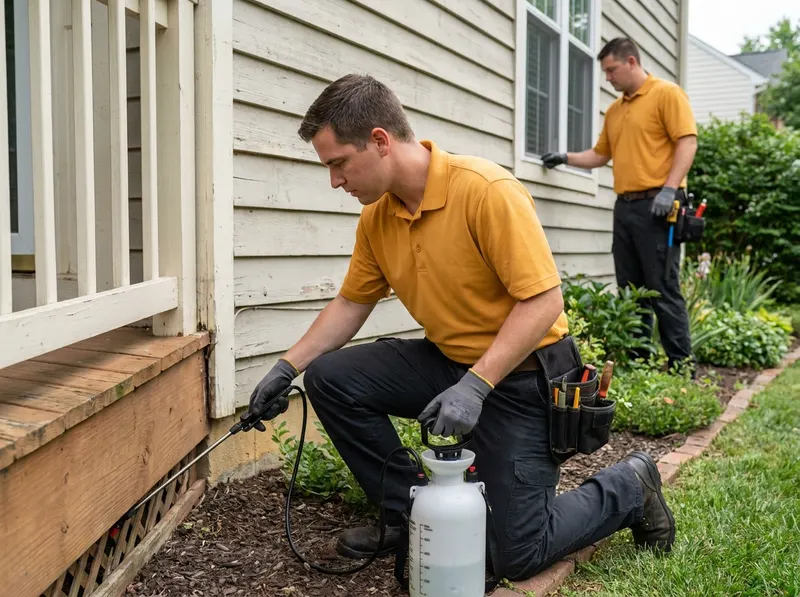
The species decides the treatment, so we start there. Carpenter ants (Camponotus pennsylvanicus) are the big black ones, roughly a quarter to a half inch, and they do not eat wood — they excavate it, kicking out frass that looks like pencil shavings mixed with insect parts. The parent colony is usually outdoors in a stump, a dying oak limb, or a landscape timber, with satellite nests pushed indoors into anything that has stayed wet: a deck ledger board, a window sill under failed caulk, the soffit under a clogged gutter run. In Virginia Run and Little Rocky Run, where lots back to mature hardwoods and the common areas near Cub Run Stream Valley Park hold shade and moisture, carpenter ant calls almost always end with us pointing a flashlight at a specific piece of damp wood. Find and fix the moisture source and the carpenter ants lose the nesting site permanently.
Odorous house ants are the opposite problem — small, dark, and numerous, running the same line along a counter edge, a baseboard, or a tub surround. Crush one and it smells like rotten coconut. Their colonies carry multiple queens and split into satellite nests readily, which is why hardware-store repellent sprays make them worse: the colony buds and you get three trails where you had one. We use non-repellent materials and slow-acting bait so foragers keep trafficking normally and carry the dose back into the void. That patience is the whole strategy, and it's why we ask you not to wipe the trail before we arrive. In the townhouse rows around Newgate, London Towne, and Centre Ridge, shared walls and slab expansion joints let one colony feed two or three units, so we treat exterior sills, weep holes, and the slab perimeter, not just the kitchen you called about.
When does DIY actually fit? A single ant on the floor after you've had the patio door open needs nothing. A trail that returns within a week of your last spray, ants coming from an interior wall rather than a door, or frass under a deck rail — those are colony problems, and repeat retail treatments usually just relocate them. The trade-off runs the other direction too: baiting is slower than spraying, and you may see ants for 7–14 days while they carry the material home. Homeowners in Compton Village, Singleton's Grove, Faircrest, Country Club Manor, and Xanadu Estates who want the trail gone in an hour need to know that visible-kill speed and actual colony elimination are different outcomes.
On safety, we place bait in cracks, voids, and tamper-resistant stations rather than open floors, and we tell you the label's re-entry time for every product before we apply it — pets and kids are a scheduling question, not an afterthought. Older Fairfax County construction from the Newgate era and newer slab-on-grade builds each have their own weak points, and we photograph what we find: garage door sweeps worn at the corners, siding gaps behind the hose bib, mulch piled above the brick line. Sealing those is the difference between a treatment and a fix. Find the entry point. Seal it.
Every job gets a firm, written price after a free on-site visit.
Tell us about your ant control (carpenter & odorous house ants) job in Centreville and we'll send a clear, written quote — usually the same day.
 Avenza Pest Control Service