The plan fits homes with recurring pressure rather than a single sighting. If you saw one wasp on the deck in July, a one-time treatment is the honest answer. If ants come back on the kitchen counter every spring, if…
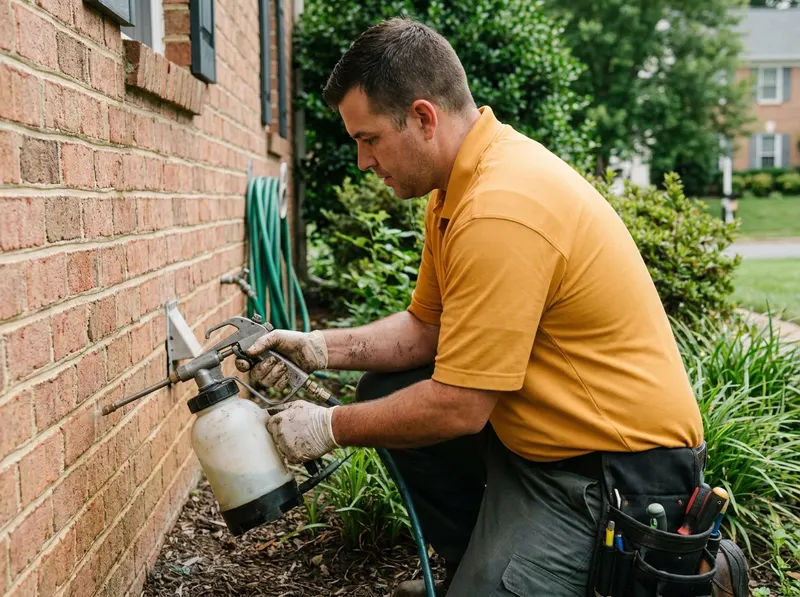
The plan fits homes with recurring pressure rather than a single sighting. If you saw one wasp on the deck in July, a one-time treatment is the honest answer. If ants come back on the kitchen counter every spring, if mice show up under the sink two falls running, or if your rear lot backs to woods, a creek corridor, or common HOA green space, the pests are re-entering from outside and a single visit only resets the clock. Quarterly timing exists because the pressure changes: the April visit targets ant trails and nesting sites along foundations and mulch beds, the summer visit catches wasp and hornet nests building under soffits and deck ledger boards, the fall visit is the rodent and stink bug visit, and the winter visit checks the interior perimeter — basement sill plate, crawlspace vents, utility penetrations — where overwintering insects and mice sit out the cold.
Centreville geography drives the schedule more than the calendar does. Homes near Cub Run Stream Valley Park, Big Rocky Run, and the Bull Run corridor sit on damp, shaded soil, and moist soil next to a foundation is where odorous house ants and pavement ants nest. Wooded rear lots in Virginia Run, Little Rocky Run, and Singleton's Grove push field mice, spiders, and camel crickets toward the warmest wall on the house. Townhouse rows in Newgate, London Towne, and Country Club Manor share walls and shared attic space, so a mouse entering one end unit travels the row — which is why the plan treats the whole exterior run, not just one door. The 1980s and 1990s builds common in Compton Village, Centre Ridge, Faircrest, and Xanadu Estates have the two gaps we look for on nearly every visit: a garage door sweep worn thin at the corners, and siding or brick weep holes wide enough for a mouse that only needs a quarter-inch.
The trade-off is honest. A quarterly plan costs more over a year than one treatment, and it does not make a house pest-proof by itself. Chemistry knocks down what is already active; sealing is what stops the next one. So every visit ends with the same conversation — here is what we treated, here is the gap we found, here is what it takes to close it. Find the entry point. Seal it. Exclusion work such as door sweeps, vent screening, or sealing pipe penetrations is quoted separately so you can decide, and you are never charged for a repair you did not approve.
Product safety comes up on almost every call from parents and dog owners. Materials are applied per label directions, mostly to the exterior perimeter and to cracks and voids rather than open floors, and we tell you the re-entry time for any interior application before we start — usually until the treated surface is dry. Bowls, toys, and garden beds get pointed out and worked around. A quote is given before any application, and it does not change afterward. Call (571) 741-0060 and we will schedule the inspection first; the plan only makes sense if we can show you why the pressure keeps coming back.
Every job gets a firm, written price after a free on-site visit.
Tell us about your quarterly home pest protection plan job in Centreville and we'll send a clear, written quote — usually the same day.
 Avenza Pest Control Service