Different species need different work, so the visit starts with identification. Paper wasps build the open, umbrella-shaped comb tucked under shutters, gable peaks, porch ceilings, and grill covers — common on the…
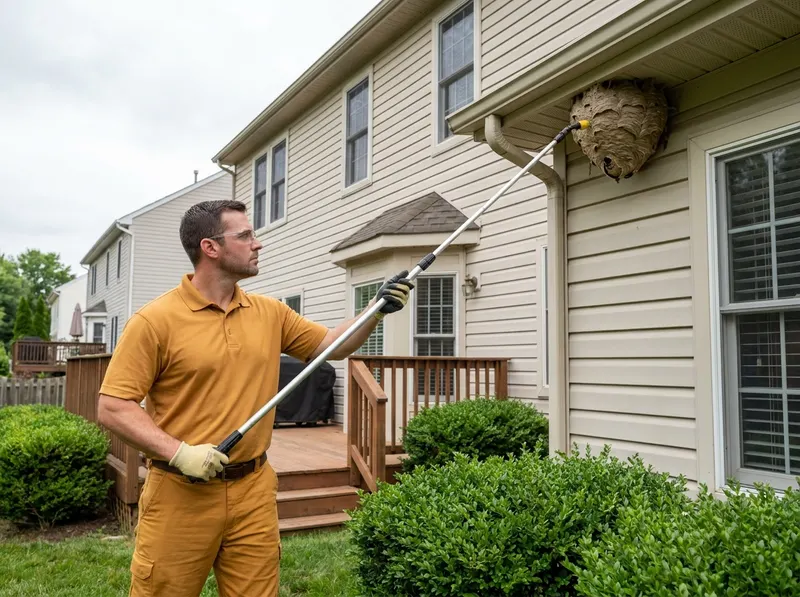
Different species need different work, so the visit starts with identification. Paper wasps build the open, umbrella-shaped comb tucked under shutters, gable peaks, porch ceilings, and grill covers — common on the colonial siding through Virginia Run and Compton Village, and usually reachable from a ladder. Bald-faced hornets build the gray football-shaped aerial nest in tree lines and shrub tops, and those show up most often on lots that back to the wooded edges near Cub Run Stream Valley Park and E.C. Lawrence Park. Eastern yellowjackets nest underground or inside a wall void, entering through a single hole in a mulch bed, a stump, or a siding gap — those are the ones that put people in urgent care in late August, because a mature colony can hold thousands of workers and defends the entrance aggressively when the ground vibrates. European hornets are the large brown-and-yellow insect that thumps porch lights and screen doors after dark and nests in hollow trees and wall voids. Species determines whether the nest gets removed, treated in place, or left alone.
Some nests should not be treated at all, and we say so on site. Mud daubers build the tube-shaped clay nests on brick and under deck framing, sting almost never, and actually prey on spiders. Cicada killers are the big solitary wasps that dig single burrows in the dry, sunny turf strips found along many Centreville sidewalks and driveway edges in July — one insect per hole, no colony to defend. Honeybees are also a separate matter: a honeybee swarm or a colony in a wall is a beekeeper's job, not a pesticide job, and we will identify it and tell you rather than treat it.
The decision most homeowners are weighing is spray-it-yourself versus a service call. A hardware-store aerosol can genuinely work on a small, new paper wasp comb you can stand under with clear footing and an escape route. It works poorly on the two situations we see most: an aerial hornet nest 15 to 25 feet up, and a yellowjacket colony inside a wall or soffit void. Void colonies are where DIY goes wrong in the townhouse rows through Newgate, London Towne, and Centre Ridge — foam sprayed into the entry hole seals the outside exit, and the workers then chew inward toward the drywall and come out in the bedroom. A void colony gets treated at the entry point and left open until traffic stops, then sealed. That sequence is the whole difference.
Exclusion is what keeps the second call from happening. After the colony is down, the technician goes after the reason the queen chose that spot: unscreened gable and ridge vents, gaps behind shutter clips, the seam where a deck ledger board meets siding, torn crawlspace vent screen, and the underside of grill covers and playsets in Little Rocky Run, Singleton's Grove, Faircrest, Country Club Manor, and Xanadu Estates. Overwintered queens start scouting eaves in April, colonies peak in size and temper from mid-August through the first hard frost, and a nest site that stays open often gets reused by a new queen the following spring. Price is quoted before anything is sprayed, and no ongoing contract is required for a one-time nest removal.
Every job gets a firm, written price after a free on-site visit.
Tell us about your wasp, hornet & yellowjacket nest removal job in Centreville and we'll send a clear, written quote — usually the same day.
 Avenza Pest Control Service