Avenza Pest Control ServiceAvenza Pest Control Service

Termite Inspection & Treatment

Termites are found in Centreville because the conditions favor them: Fairfax County clay holds moisture near foundations, and much of the housing stock in Virginia Run, Little Rocky Run, Compton Village and Singleton's…
Call (571) 741-0060 →(571) 741-0060
Termite Inspection & Treatment in Centreville, VA
Quick answer
  • What's included: a foundation-to-framing inspection — exterior perimeter, crawlspace or slab edge, garage, sill plates, deck ledger boards, and any accessible wood — with photos of every mud tube, damaged board, or discarded swarmer wing found.
  • How fast: most Centreville inspections are scheduled within the same week, and a single-family inspection takes 45 to 90 minutes depending on crawlspace access.
  • What it costs: inspections start at $250; liquid perimeter treatments on a typical Centreville home generally land between $1,200 and $2,800 — a ballpark, with the exact figure confirmed on site after the linear footage is measured.
  • What we treat: active Eastern subterranean termite infestations, plus preventive perimeter work and bait station monitoring; we do not perform structural carpentry, and damaged joists or band boards go to a contractor.
  • How to book: call (571) 741-0060 for a Centreville inspection window; you get findings and a written price before any product is applied.

Termites are found in Centreville because the conditions favor them: Fairfax County clay holds moisture near foundations, and much of the housing stock in Virginia Run, Little Rocky Run, Compton Village and Singleton's Grove was built in the 1980s and early 1990s with deep mulch beds, wooden deck posts set close to grade, and brick veneer whose weep holes sit inches above soil. Colonies forage in the soil and enter through cracks in a slab, an expansion joint at the garage, a foundation penetration for a hose bib, or the back of a deck ledger board. In March through May, especially after a warm rain, homeowners near Cub Run Stream Valley Park and Bull Run Regional Park call about winged swarmers on a sunny windowsill or a small pile of identical shed wings by the front door. Swarmers indoors mean a colony is already inside or under the structure — that is the one termite sign that should never wait.

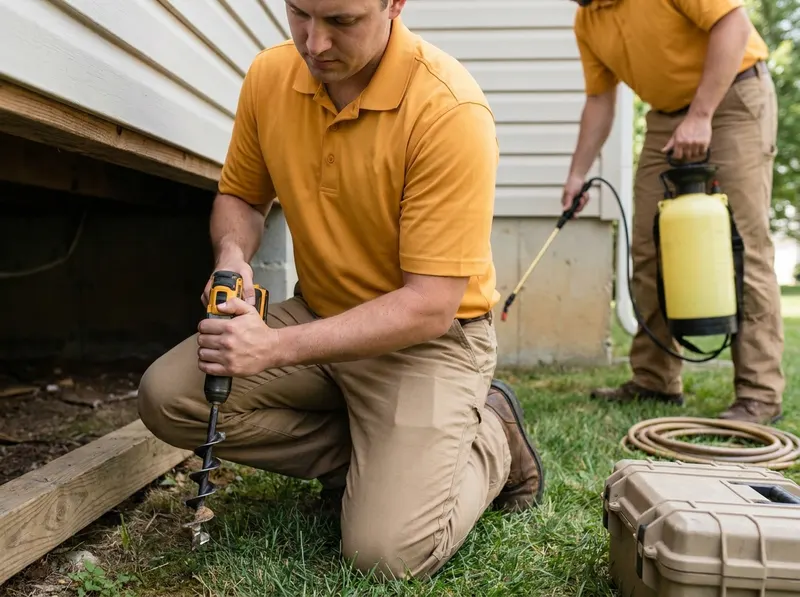
The decision most Centreville homeowners face is spot treatment versus a full perimeter treatment. A spot treatment targets one identified area — a garage stem wall, a single deck post, a section of crawlspace sill — and costs less, but it only protects what it touches; if the colony is foraging along a different face of the foundation, you can see fresh mud tubes elsewhere within a season. A full liquid perimeter treatment creates a continuous treated zone around the entire foundation, applied by trenching and rodding soil against the wall and, where needed, drilling and injecting through slab or driveway edges. It costs more up front and is the standard answer for confirmed active infestations. Bait station systems are the other route — stations installed in the soil around the home and checked on a schedule, which suits properties in Newgate, London Towne and Centre Ridge where townhouse rows, shared foundation walls, or hardscape make a continuous trench difficult.

Townhouses change the math. In an attached row, a colony under one unit is a colony under the block, so we inspect what is accessible on your unit, document it clearly, and tell you plainly when the neighboring unit or the HOA needs to be looped in. Small landlords and HOA-managed owners around Faircrest, Country Club Manor and Xanadu Estates usually want the report for that exact reason. For pending home sales, lenders and buyers commonly ask for a wood-destroying insect report on the industry-standard NPMA-33 form — an inspection with documented findings, not a treatment.

Everything here follows the same philosophy as the rest of our work: find the entry point and eliminate the wood-to-soil contact that created it. That means we will tell you when the real fix is regrading mulch away from siding, correcting a downspout that dumps against the foundation, or pulling stored lumber off a crawlspace floor — recommendations that cost you nothing and matter more than any additional gallon of product. On safety, we walk you through the label directions for what is being applied, where it goes, and how long to keep pets and kids off treated soil, before we start rather than after.

What it costs

Termite inspection with written findings and photos$250
Wood-destroying insect report (NPMA-33) for a home sale$250 - $400
Spot / localized treatment (single area, e.g. garage wall or deck post)$350 - $800
Full liquid perimeter treatment, single-family home$1,200 - $2,800
Liquid perimeter treatment, townhouse / end unit$900 - $1,900
Bait station system installation around foundation$1,000 - $1,800
Annual bait monitoring / re-inspection visit$250 - $450

Every job gets a firm, written price after a free on-site visit.

Common questions

How do I know if I have termites and not ants in my Centreville home?
Termite swarmers have two pairs of equal-length wings, a straight waist, and straight antennae; flying ants have a pinched waist, elbowed antennae, and a longer front wing pair. In Centreville, discarded wings on a windowsill and pencil-thin mud tubes running up a foundation wall or crawlspace pier point to Eastern subterranean termites. Carpenter ants leave coarse sawdust-like shavings instead of mud. Photograph what you find and call (571) 741-0060 — species identification decides the whole treatment plan.
When do termites swarm in Centreville, VA?
Eastern subterranean termites in Centreville typically swarm from March into May, often on a warm, humid afternoon within a day or two of rain. Swarmers emerging inside the house — on a basement window, a sunroom floor, or near a slab crack — indicate an established colony in or beneath the structure. Swarmers outside near a stump or landscape timber mean a colony on the property, which still warrants an inspection of the foundation line.
Do I need a termite inspection to sell a house in Centreville?
Most lenders and buyers in the Centreville and wider Fairfax County market request a wood-destroying insect report, commonly the NPMA-33 form, as part of closing. That report documents visible evidence of termites and other wood-destroying insects, plus conditions conducive to infestation such as wood-to-soil contact or excess crawlspace moisture. Inspections for a pending sale start at $250 and are usually scheduled within the same week.
Will termite treatment in Centreville be safe for my dog and my vegetable garden?
Safety comes down to placement and label directions, and we cover both before we begin. Liquid termiticide goes into soil trenches against the foundation and into drilled slab injection points — not on lawn surfaces, not on plants, and not in living areas. We ask about pets, children, and any garden beds near the foundation during the Centreville inspection, keep applications off edible plantings, and give you a specific re-entry window for treated soil rather than a vague 'wait a while.'
Can I treat termites myself with hardware-store products in Centreville?
Over-the-counter sprays and foams reach the termites you can see, not the soil colony feeding them, which is why homeowners across Centreville often report fresh mud tubes a few months after a DIY attempt. Effective control requires a continuous treated soil zone around the foundation or a monitored bait system, applied at label rates and depths, plus correction of the wood-to-soil contact that let them in. The inspection is the part worth paying for first — it tells you whether you have an active colony at all.

Ready to get started?

Tell us about your termite inspection & treatment job in Centreville and we'll send a clear, written quote — usually the same day.